
The distinct Windsor-style has contributed to the success of local pizzerias. From shredded pepperoni, Galati Cheese, canned mushrooms, and cornmeal-dusted crust to family environments, Windsor-style pizza has remained constant across Windsor and Essex County. But has Windsor-style pizza been able to resist big chains like Domino's or Little Caesars, and how does Windsor-style pizza compare to the signature offerings in other notable “pizza cities”?
Begin ExploringIt is no secret that Windsorites love their pizza, and the proof is not just in the reviews but in the numbers. Windsor has at least 62 locally owned and operated pizzerias that all follow the Windsor-style pizza recipe. In comparison, there are only 46 large-chain pizzerias, including Domino’s, Little Caesars, Pizza Pizza, Pizza Depot, Pizza Hut, Red Swan, and Boston Pizza.26
According to Joe Carivino, owner of Antonino’s Pizza, “Windsor-Essex may have more pizza eaters than anywhere else in North America, but their tastes are very discerning… national chains close locations here and sometimes pull out of the market completely.”27
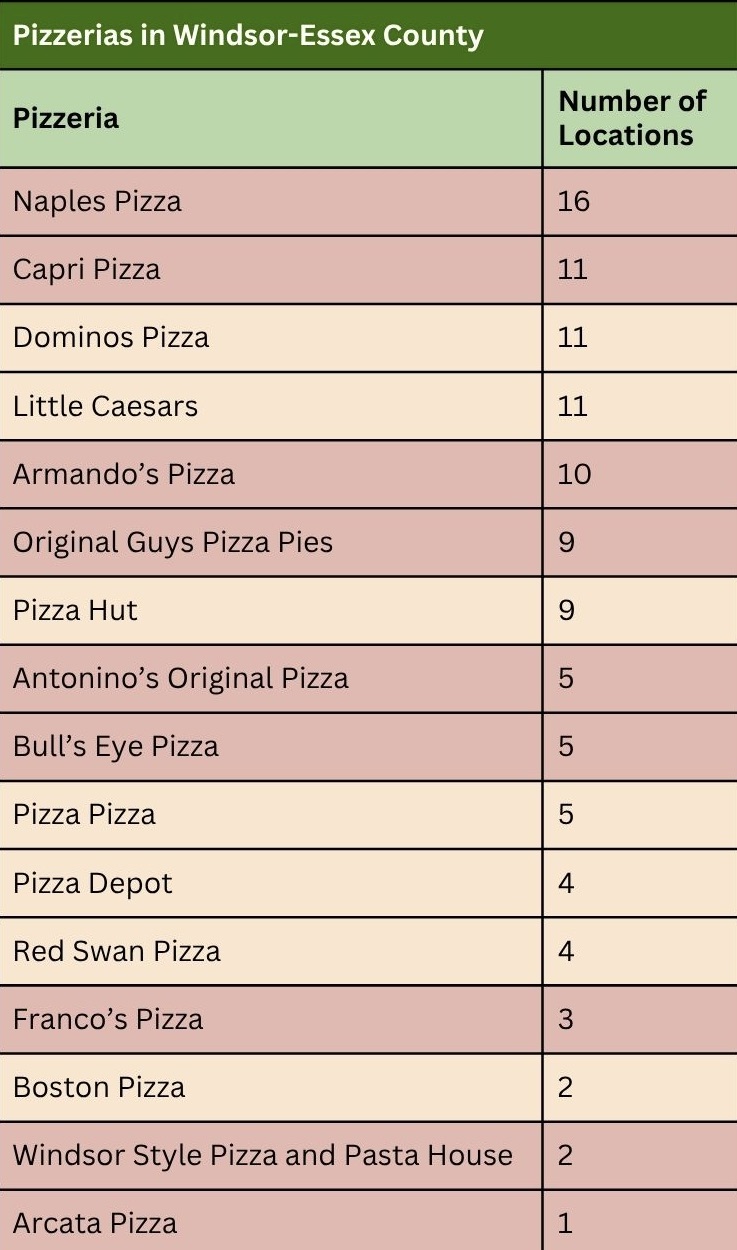
Sixty-two Windsor-style pizzerias vs forty-six chain locations in Windsor.
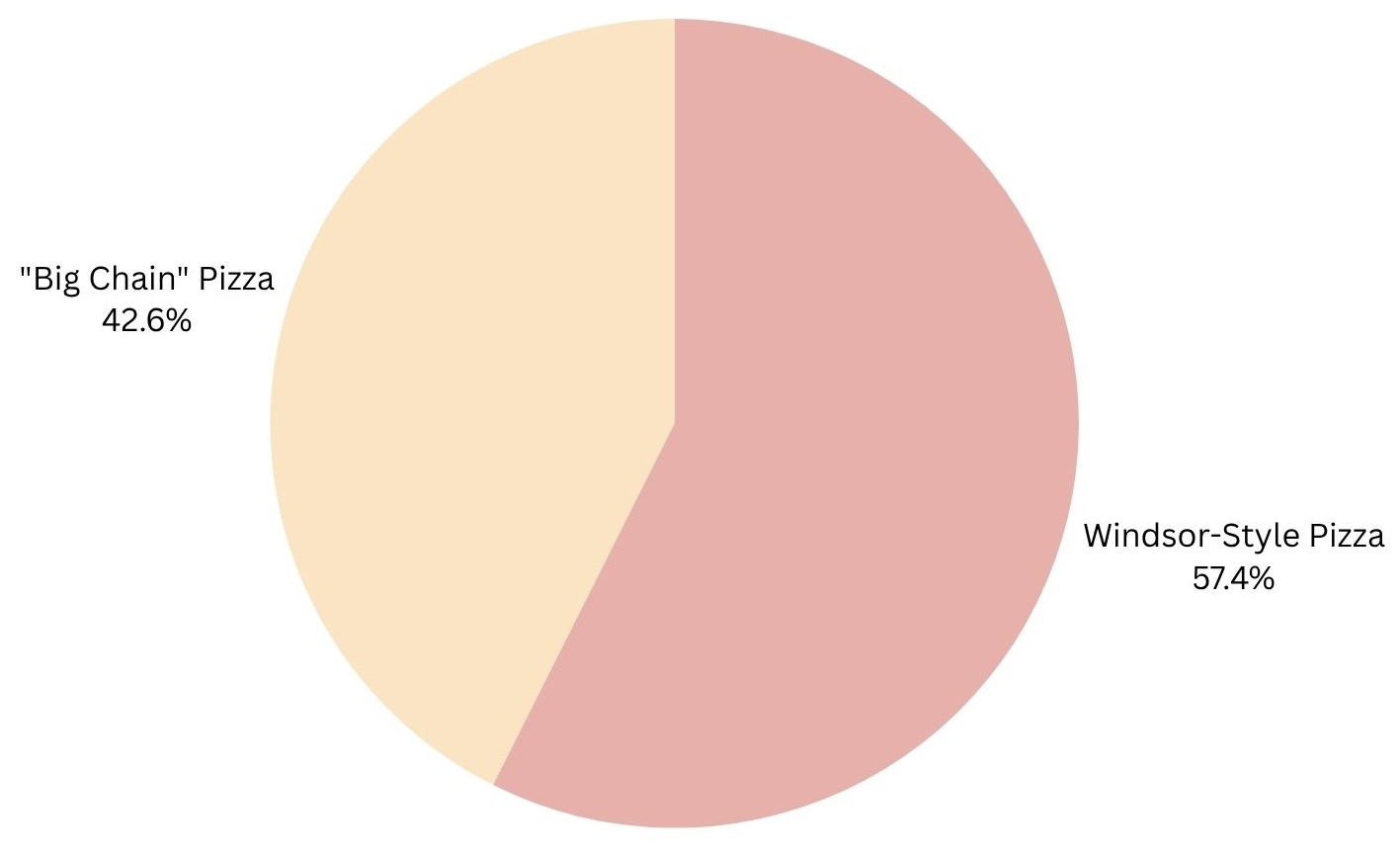
Windsor-style pizza makes up 57.4% of the local market share.
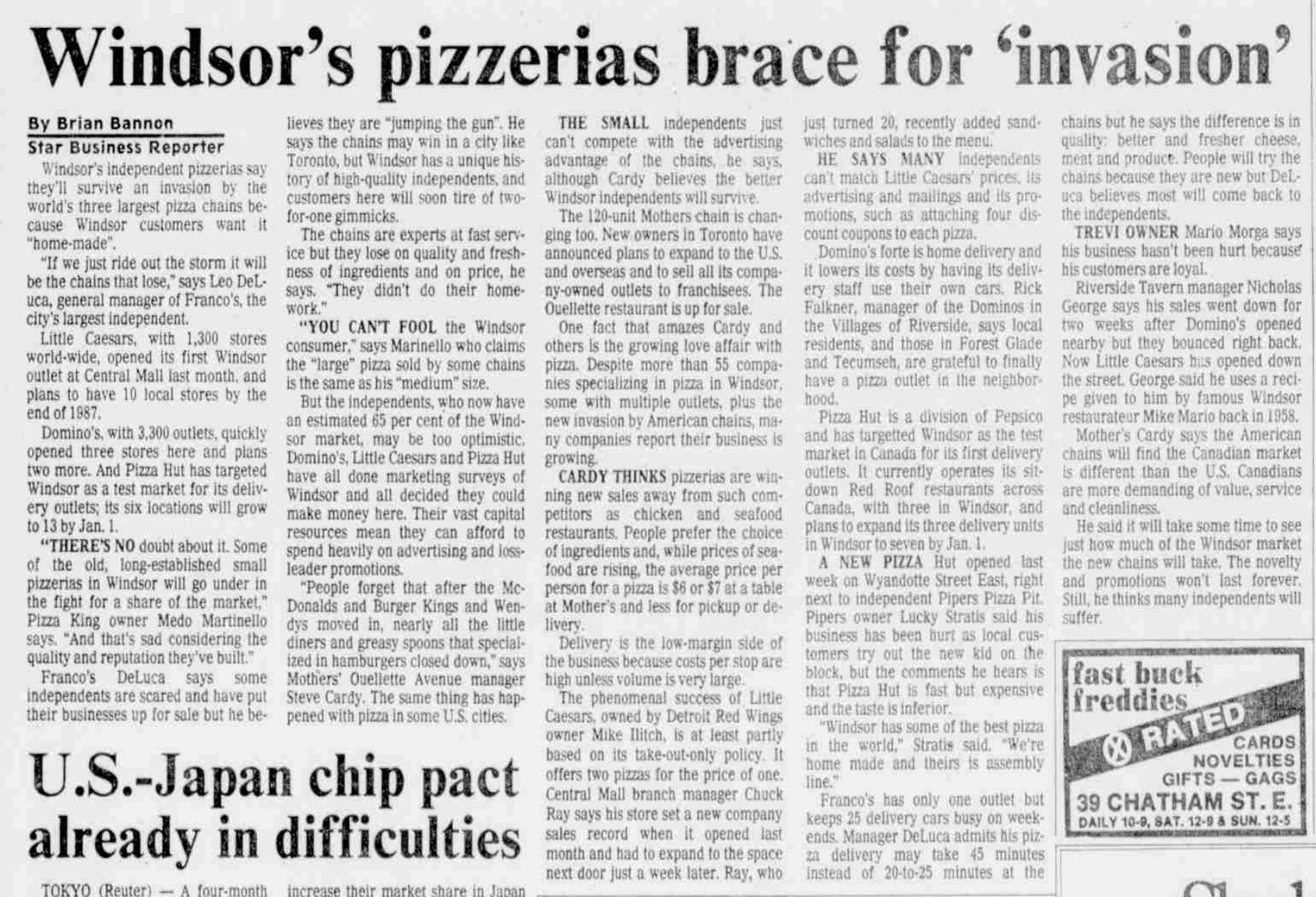
An article about the invasion of big chains in Windsor's pizza industry. Retrieved from the Windsor Star, December 2, 1986.
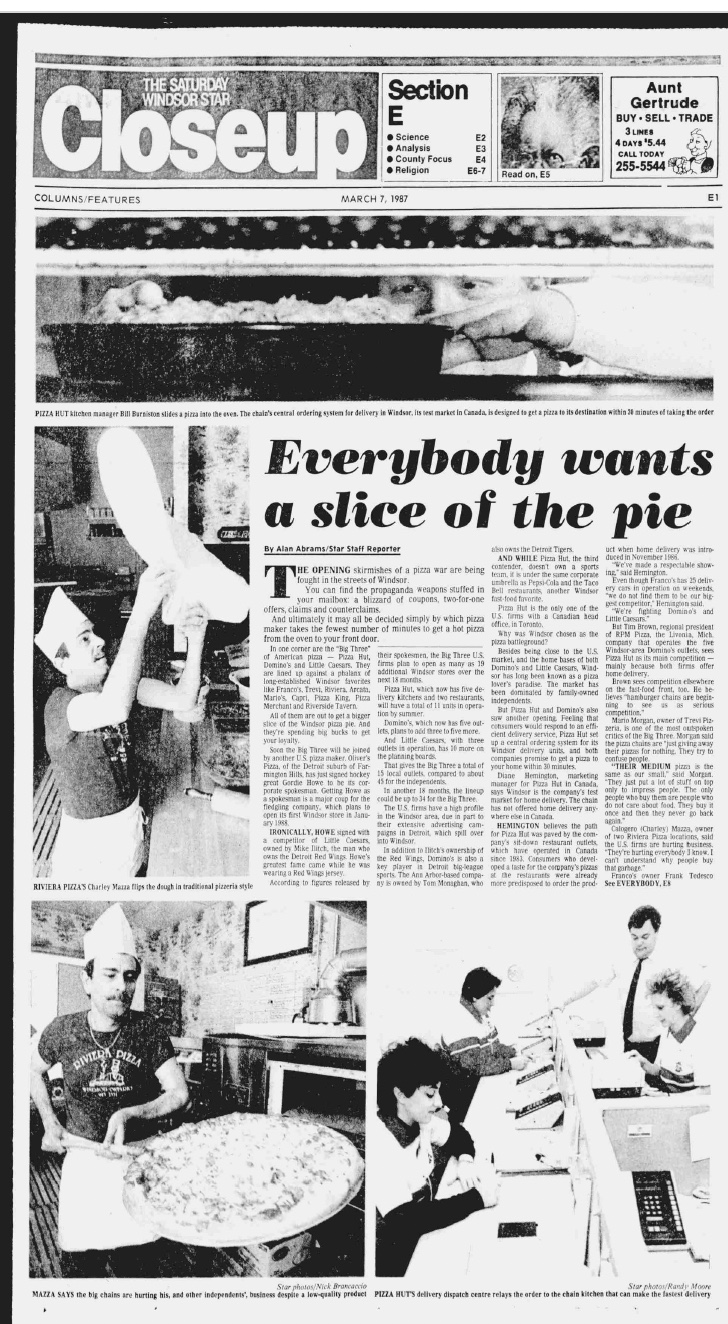
An article about the pizza war in Windsor. Retrieved from the Windsor Star, March 7, 1987.
The infiltration of major chains was not limited to the pizza market. Over the decades, small-town diners, grocery stores, and shops have been forced to close as major retailers have entered the market. Fast Food Nation by Eric Schlosser explains how, in the early 1970s, activists warned about the “McDonaldization of America.” Many of those concerns became a reality, as independent stores moved out and large chains moved in.
These chain stores valued uniformity, drawing customers in through familiarity. However, one irony of these industries is that their founders rarely attended college and were often self-made. According to Schlosser, fast food has embodied the best and worst of American capitalism. The industrialization of the kitchen has enabled chains to rely on low-paid, unskilled workers. Although some workers rise up the ranks, many lack full-time employment, receive no benefits, learn few skills, and often quit.28 According to a 1986 Windsor Star article, as McDonald’s, Burger King, and Wendy’s moved in, independent diners closed. Independents could not compete with the advertising power of larger chains.29 American capitalism has enabled the expansion of major chains into cities around the world, including Canadian cities, pushing out many independently owned retailers. However, Windsor’s pizza scene has somehow resisted this driving force of big chains.
A 1986 Windsor Star article, “Windsor’s pizzerias brace for ‘invasion’,” explains how local pizzerias believed they would survive the arrival of the world’s three largest pizza chains because their customers preferred “home-made.” Although some pizzerias were hesitant, others trusted their customer base and the strength of their local identity. A 1987 Windsor Star article takes a more critical view of the future of Windsor-style pizzerias. It describes the ongoing “war” between independents and the big three (Little Caesars, Domino’s, and Pizza Hut). At the time, chains had 15 local outlets compared to 45 independents, though the gap was believed to be narrowing. The U.S. firms credited their success to Windsor’s proximity to Detroit and the advertising that spilled across the border. Still, local pizza owners, such as Franco’s owner, noted that sales were affected only during the first week. After customers tried the chains, many returned to independents.30 Fast-forward almost 40 years, and Windsor-style pizzerias have held strong. Although some have closed, many have expanded, and new independent pizzerias have opened, all following the Windsor-style recipe. Their success comes from a consistent focus on quality and strong customer relationships. It is not that Windsorites do not order from large chains, but rather that they often do so when they want something cheap and convenient. Even so, local pizzerias remain the first choice for many Windsorites loyal to Windsor-style pizza. These pizzerias have maintained their recipes across generations and locations, while continuing to source ingredients locally and sustain a skilled, community-based workforce.
Detroit-style pizza has developed a strong regional identity but major franchises like Little Caesars and Domino’s often overshadow it. In 1944, Gus Guerra, an Italian immigrant, became a partner at Buddy’s Rendezvous. In 1946, Gus invented Detroit-style pizza by using bread pans and his mother-in-law’s pizza recipe to create the now-famous Detroit pan pizza. Buddy’s Pizza went on to become a key reference point in Detroit’s pizza scene, often serving as the standard against which other pizzerias were compared.31
As pizza grew in popularity across the United States, regional pizza identities began to decline under the pressure of franchise expansion, mass production, standardization, and efficiency. One of the most recognizable pizza chains in the world, Domino’s (originally Dominick’s) in Michigan, opened in 1960. Domino’s gained popularity not primarily for its taste but for its reliability. Another major franchise that emerged in Michigan was Little Caesars, which was founded by Mike Ilitch in 1959. Between 1961 and 1992, it expanded from 2 to 4,000 outlets.32
Although Detroit still maintains an identity through Buddy’s Pizza, which continues today, pizza franchises in the United States have increasingly shifted toward standardized, mass-produced products rather than distinct regional identities. Even though Detroit still has its Detroit-style pizza, the quality has been debated. In 1953, Gus sold Buddy’s, which has since had four owners or investors. As a result, current owners who recently took over Buddy’s have stated that customers have raised concerns about quality. They also explained that the pizza has struggled to expand beyond central Detroit and that the recipe has changed over time.33 As a result, it has been a challenge for pizza in Detroit to maintain its signature style and identity, which increasingly overlaps with those of large chains like Little Caesars and Domino’s. In contrast, Windsor-style pizzerias have adapted to changing markets while maintaining their identity and continuing to grow their customer base.
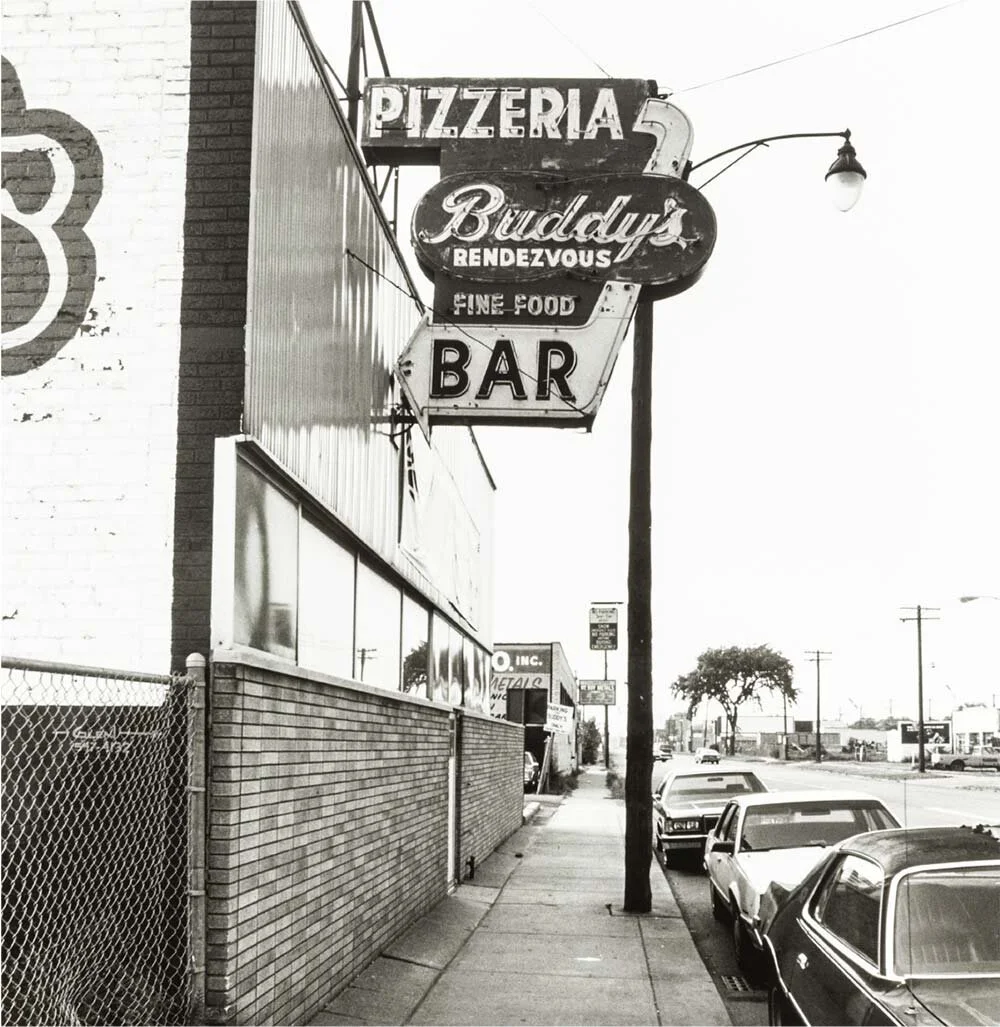
Buddy's Rendezvous opened in 1946. Curtsey to Buddy's Rendezvous. Retrieved from Metro West Pizza.
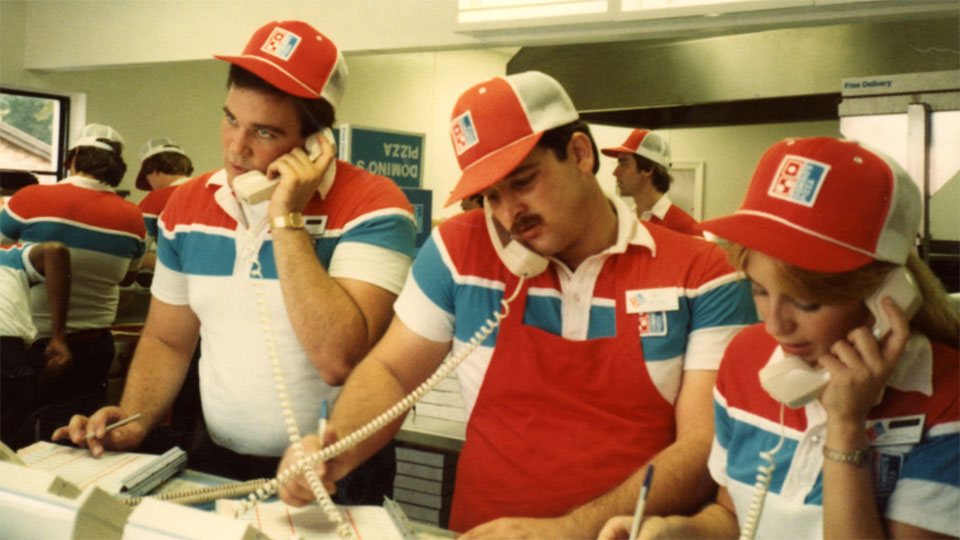
Dominos Pizza employees. Retrieved from Domino's Pizza.
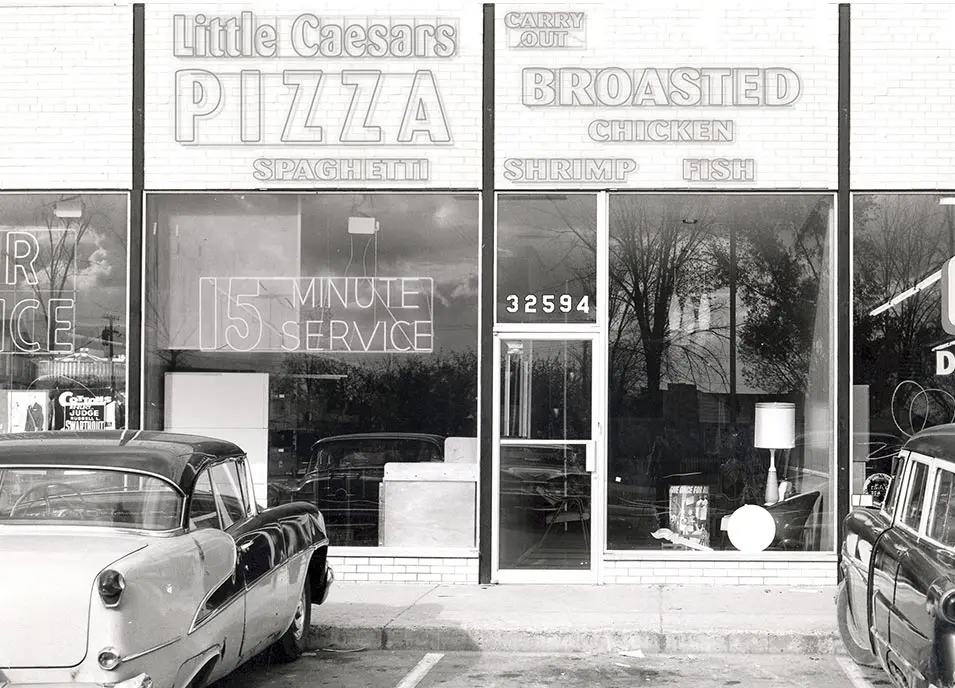
Mike and Marian Ilitch invested their life savings into their first pizza store in Garden City, Michigan. Retrieved from Little Caesars.
Use this lesson about "Sticking to the Recipe" in your classroom. The provided lesson is best suited for Grade 10 History and Grade 11 Food and Culture.
Download Lesson Plan PDF Download Sorting Cards Download Sticking to the Recipe Slides